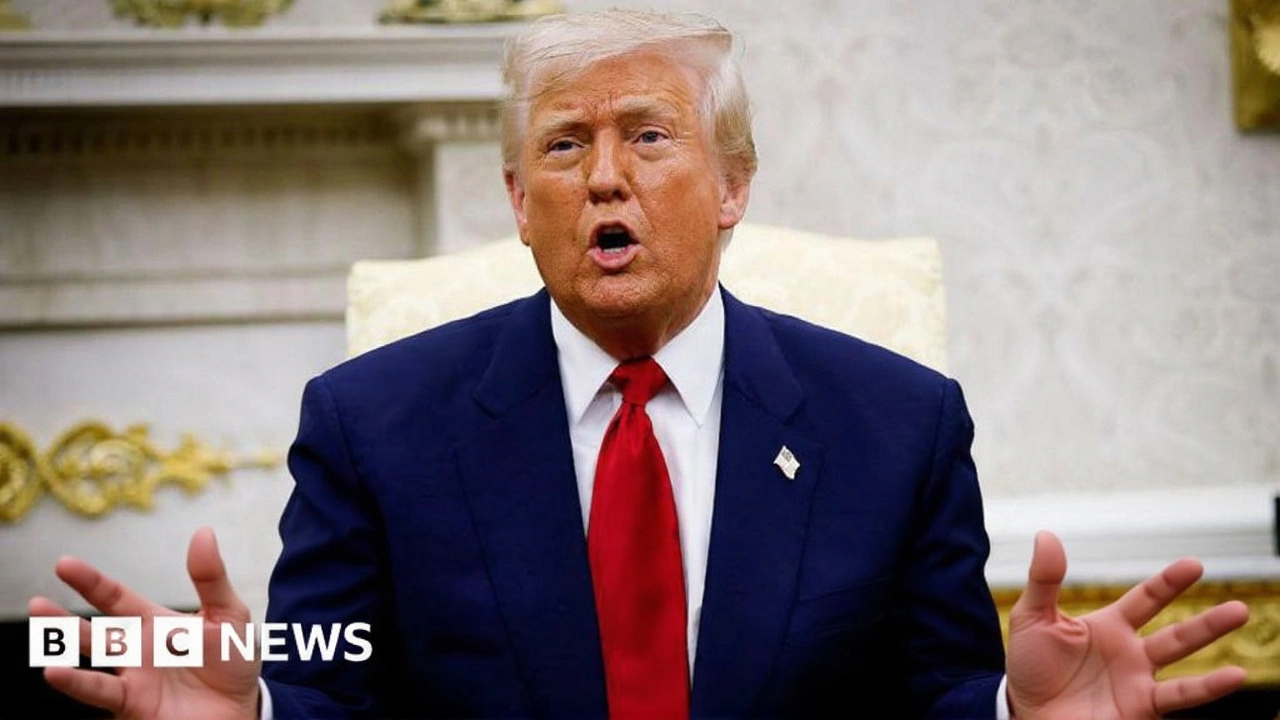
On August 1, 2025, the Trump administration quietly reversed course on one of its most aggressive trade moves—exempting smartphones, computers, and semiconductors from a sweeping global tariff regime that had threatened to slap a 145% tax on Chinese-made Apple iPhones and a 10% levy on critical chips. The move, announced through U.S. Customs and Border Protection’s Federal Register Notice CBP-2025-008787, came just hours after Apple Inc. revealed it had already absorbed $800 million in tariff costs during Q3 2025, with another $1.1 billion looming in Q4. It was less an olive branch and more a tactical retreat, forced by economic reality and relentless pressure from tech giants and economists alike.
Why the U-turn happened
The decision wasn’t born in a boardroom. It was born in living rooms. The Consumer Technology Association and the Semiconductor Industry Association had spent months warning the White House: raise tariffs on electronics, and American families pay the price. A July 24, 2025, Federal Reserve Bank of New York report projected a 4.2% spike in inflation if those tariffs stayed. That’s not a number—it’s groceries, gas, and rent going up for millions. By early August, even administration insiders were privately admitting the math didn’t add up.
President Donald J. Trump had spent months demanding Apple move iPhone production out of China. In a May 3, 2025, Rose Garden press conference, he threatened 25% tariffs on every iPhone. He doubled down in a private Oval Office meeting with Timothy D. Cook on May 18. But Cook didn’t blink. He showed the president spreadsheets: relocating iPhone assembly would cost $42.3 billion in new U.S. factories, add $18.7 billion annually in logistics, and take nearly three years to scale. The numbers were brutal.
Apple’s quiet defiance
On August 5, 2025, in an Axios interview at Apple Park, Cook dropped a line that echoed through Silicon Valley: "The company has no plans to move iPhone assembly to the U.S. That will be elsewhere for a while." It wasn’t defiance—it was realism. He didn’t say no to investment. He said yes to $100 billion in U.S. infrastructure over five years: data centers, chip design labs, AI research hubs. But the assembly line? Still in Shenzhen. And for good reason.
Wedbush Securities analyst Dan Ives put it bluntly in a research note on August 4: "We see no chance that iPhone production starts to happen in the U.S. in the near-term." Why? Because building 78 specialized component factories—each requiring precision tools, trained workers, and just-in-time logistics—isn’t a matter of funding. It’s a matter of geography. Those factories exist in Shenzhen. Not in Ohio. Not in Arizona. And re-creating that ecosystem would push the price of an iPhone past $3,500.

The China factor—and the India distraction
The exemption covers $327.4 billion in Chinese electronics exports to the U.S. in 2024—38.7% of all Chinese exports. That’s not just phones. It’s laptops, tablets, processors, and the tiny chips inside them. Harmonized Tariff Schedule codes 8517.12.00 (smartphones), 8471.30.01 (laptops), and 8542.31.00 (CPUs) are now clear. The rule applies retroactively to imports from August 1, 12:01 a.m. ET. U.S. Customs has already begun processing refunds.
But here’s the twist: while exempting China, Trump doubled tariffs on India to 50% on August 6, citing its $5.2 billion monthly purchases of Russian crude. That’s a problem for Apple. Its backup plan—shifting 20% of iPhone 16 production to Tata Group’s facility in Hoskote, Karnataka—just got a lot more expensive. The move was meant to diversify away from China. Now, it’s caught in a crossfire of American trade policy.
What’s still taxed—and why
This isn’t a full surrender. The 25% tariffs on $300 billion in Chinese industrial goods under Section 301 remain untouched. The administration still frames them as punishment for IP theft and forced tech transfers. And they’re not backing off on steel, aluminum, or rare earth minerals. This exemption is surgical: protect the consumer, not the strategy.
It’s a sign the Trump administration is learning. You can’t tax your way to industrial dominance when your own citizens are paying the bill. The White House didn’t change its stance on China. It just realized the cost of enforcement was too high.

What’s next?
Apple’s $100 billion U.S. investment will likely focus on chip design and AI—not assembly. The Semiconductor Industry Association is already lobbying for tax credits to build domestic wafer fabs. Meanwhile, the U.S. International Trade Commission is reviewing whether to expand the exemption to other consumer electronics. And India? They’re quietly negotiating a carve-out.
One thing’s clear: the trade war didn’t end. It evolved. And this time, the market—not the mandate—got the last word.
Frequently Asked Questions
Why were smartphones and computers exempted but not other Chinese goods?
Smartphones and computers were exempted because they represent the largest single category of Chinese exports to the U.S.—$327.4 billion in 2024—and directly impact consumer inflation. Federal Reserve data showed electronics tariffs could push inflation up 4.2%, threatening economic stability. Other goods, like steel and machinery, are seen as strategic industrial inputs where the administration still seeks to force reshoring.
Did Apple agree to move iPhone production to the U.S.?
No. Apple CEO Timothy D. Cook explicitly stated in an August 5, 2025, interview that iPhone assembly will remain outside the U.S. for the foreseeable future. Instead, Apple pledged $100 billion in U.S. investment over five years—focused on chip design, AI research, and data centers—not manufacturing. The cost and logistical barriers, analysts say, make U.S. assembly economically unfeasible.
How did the exemption affect Apple’s financials?
Apple incurred $800 million in tariff costs during Q3 2025 (April–June) and projected $1.1 billion in Q4 2025 (July–September). The August 1 exemption will refund duties on shipments entered after that date, potentially saving Apple hundreds of millions in the coming quarters. However, the company still faces costs from tariffs on components sourced from other countries, like India.
Why did Trump raise tariffs on India at the same time?
Trump doubled India’s tariffs to 50% on August 6, 2025, citing its $5.2 billion monthly imports of Russian crude oil. This targeted India’s role as a geopolitical middleman and disrupted Apple’s backup plan to shift some iPhone production to Tata Group’s facility in Karnataka. The move shows the administration’s trade policy remains politically driven, even as it makes pragmatic exceptions on consumer goods.
Will this exemption last, or is it temporary?
The exemption is currently effective as of August 1, 2025, with no expiration date stated. But past trade exemptions under Trump have been revoked when political pressure shifted. Analysts believe this one will hold unless inflation drops sharply or Apple announces a major U.S. assembly breakthrough. For now, it’s a pause—not a peace treaty.
What does this mean for global supply chains?
It reinforces that China remains the irreplaceable hub for consumer electronics manufacturing. Even with rising labor costs, the density of suppliers, skilled labor, and logistics infrastructure in Shenzhen and Guangdong is unmatched. The exemption signals to global firms: don’t expect the U.S. to fully decouple from China anytime soon. The cost of doing so is simply too high.